
Driveway Extension Cost (2026): Concrete, Pavers, Gravel or Asphalt
Updated
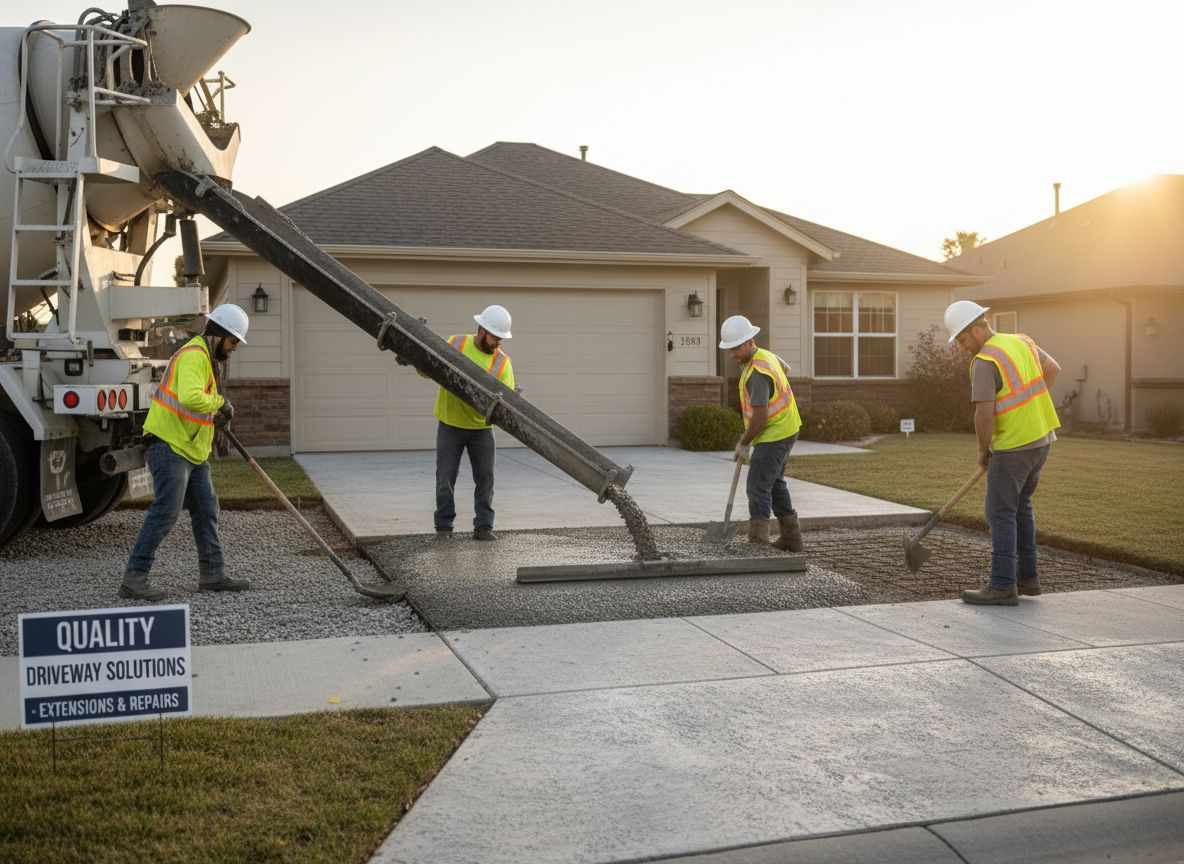
Verdict Hire a pro · Concrete
Extending a driveway costs $1,440–$1,840 to do yourself and $1,600–$3,200 to hire a pro, per 200 sq ft extension (10×20 parking strip).
Hire a crew for a concrete extension: a 10×20 pour is about $1,640 in materials, forms and rentals against $2,200, and that $560 only pays if you've poured before and have a helper for the 90 minutes that decide whether it's flat. Hire for asphalt without exception — bagged cold-mix costs more than a contractor and never hardens properly. Build it yourself in gravel or pavers: a 10×20 gravel strip is about $750 in stone, fabric, edging and a compactor rental against $1,000, and pavers are about $1,925 against $3,500 — the biggest saving on this page, for 24–40 hours of careful base work that forgives mistakes.
- DIY Gravel
- Hire Concrete
- Hire Asphalt
- DIY Concrete pavers
- DIY cost
- $1,440–$1,840
- 16–26 hours of your time · concrete
- Pro cost
- $1,600–$3,200
- typical $2,200 · per 200 sq ft extension (10×20 parking strip)
- Typical savings
- $560
- 25% less than a pro · ≈ $27/hour for your time
- For a 200 sq ft strip (one more car), pros charge about $1,000 in gravel, $1,600 in asphalt, $2,200 in concrete and $3,500 in pavers — $3–$25 per square foot installed, with small-job minimums pushing the low end up.
- Pavers are the DIY win: about $1,925 in pavers, base, sand and rentals against $3,500, a $1,575 saving for 24–40 hours. Gravel saves about $250 for a weekend; concrete about $560 if you've poured before.
- Asphalt is hire-only. There's no homeowner hot-mix pour, and bagged cold-mix for 200 sq ft costs $2,360 against a $1,600 crew — and never hardens properly.
- Check impervious-cover limits, driveway-width rules and the HOA before you dig. An extension that breaks them is a removal order, and anything touching the curb or sidewalk is a right-of-way permit.
DIY vs pro at a glance
| DIY | Pro | |
|---|---|---|
| Cost per job (concrete) | $1,440–$1,840 | $1,600–$3,200 |
| Cost range (all sizes) | $550–$2,125 | $600–$5,000 |
| Your time | 16–26 hours | Getting quotes, ~1–2 hours |
| Skill needed | Intermediate | None |
| Injury / damage risk | Low | Carried by the contractor (if insured) |
| Equipment you'd need to buy or rent | Plate compactor rental, Magnesium bull float with handles, Hand float, edger, groover and steel trowel, Gloves, safety glasses, knee pads and (for concrete) rubber boots | None |
| Permit | Sometimes — you apply | Sometimes — usually pulled by the pro |
| Best when | You're building in gravel or pavers, on a flat site with no roots or rock, and can rent a plate compactor for the base | It's asphalt — there is no homeowner version of a hot-mix pour |
What pros charge for extending a driveway
| Job size | Low | Typical | High |
|---|---|---|---|
| Gravel — 6 in of compacted crushed stone over fabric, with steel or plastic edging | $600 | $1,000 | $1,500 |
| Concrete — 5 in of concrete with rebar on a 4 in compacted base, tied into the existing drive with an expansion joint | $1,600 | $2,200 | $3,200 |
| Asphalt — 2–3 in of hot-mix asphalt on a 6 in base, rolled; DIY priced with bagged cold-mix, which is the only way to do it without a paving crew | $1,000 | $1,600 | $2,400 |
| Concrete pavers — vehicular-rated pavers on 1 in of bedding sand over a 6 in compacted base, edge restraint, polymeric sand | $2,400 | $3,500 | $5,000 |
What moves the price
- Material
- Installed, per square foot: gravel $3–$7, asphalt $5–$12, concrete $8–$16, concrete pavers $12–$25, natural stone or clay brick $20–$40. Gravel and pavers are the two a homeowner can realistically build; asphalt needs a paving crew whatever the size.
- Size and minimums
- Most extensions are 100–400 sq ft — a strip alongside the drive for a second car, or a pad for a boat or RV. Small jobs carry minimum charges ($1,000–$1,500 for asphalt and concrete crews), so the per-foot rate on 100 sq ft is nearly double the rate on 400.
- Excavation and base
- The extension is dug 8–10 inches deep, and the soil hauled or spread. Roots, rock, a sprinkler system, or soft clay that needs a deeper base add $200–$1,200. Slopes and drainage fixes add more.
- Tie-in to the existing driveway
- The new surface has to meet the old one at the same height and pitch. Concrete gets an expansion joint and, ideally, dowels drilled into the old slab ($150–$600); asphalt gets a saw-cut edge and tack coat; pavers get a restraint along the joint. The tie-in is where cheap jobs fail.
- Thickness and reinforcement
- Anything cars park on gets 5 inches of concrete (6 for trucks or RVs) with rebar, 2–3 inches of asphalt on a 6-inch base, or vehicular-rated pavers on 6–8 inches of base. A 4-inch patio spec on a parking strip cracks in a few winters.
- Permits, HOA and impervious cover
- Many cities cap the share of a lot that can be paved and set a maximum driveway width at the street; HOAs regulate material and layout. Anything touching the sidewalk, curb or apron is a right-of-way permit. Fees are $0–$400; a denied extension is a removal order.
- Finish
- Broom-finished concrete, plain asphalt and standard gray pavers are the baseline. Exposed aggregate, stamping, color, a soldier-course border or a paver pattern add $400–$2,000 on a 200 sq ft strip.
Common add-ons
| Add-on | Typical cost |
|---|---|
| Remove sod, shrubs or an old surface and haul it | $150–$700 |
| Extra excavation for roots, rock or soft soil | $200–$1,200 |
| Saw-cut and dowel the tie-in to an existing concrete slab | $150–$600 |
| Curb cut or apron work in the right-of-way | $800–$3,000 |
| Channel drain or French drain along the extension | $400–$2,000 |
| Decorative finish, border or pattern | $400–$2,000 |
| Sealer (asphalt, pavers or concrete) | $100–$500 |
| Permit, HOA review and right-of-way fee | $0–$400 |
What it costs to do it yourself
Gravel: $550–$950 and 8–14 hours
| Item | Cost | Note |
|---|---|---|
| Plate compactor rental | $85 ($85/day) | Rental · every material needs a compacted base; a hand tamper isn't enough for 200 sq ft that cars park on |
| Gloves, safety glasses, knee pads and (for concrete) rubber boots | $35 | Purchase |
| Wheelbarrow | $90 | Purchase · most homeowners already own this |
| Shovel, steel rake, mattock | $70 | Purchase · most homeowners already own this |
| 4 ft level, tape, mason's line, stakes, string level | $40 | Purchase · most homeowners already own this |
| Crushed stone base and top layer, delivered | $300 | 4 in of 3/4 minus base plus 2 in of 3/4 clean or pea gravel on top; about 3.7 cubic yards |
| Landscape fabric or geotextile | $40 | Materials |
| Steel or heavy plastic edging with stakes, 60 ft | $90 | Materials |
| Disposal | $0–$150 | Dump fees, haul-away or bagging |
| Permit | $0–$250 | a permit is commonly required where the city limits impervious cover or driveway width, where the extension touches the sidewalk or curb, and by most HOAs for any change to the driveway; ask before you dig |
| Total (own common tools) | $550–$950 | typical $750 |
| Total (own nothing) | $750–$1,150 | buying every tool listed |
Concrete: $1,440–$1,840 and 16–26 hours
| Item | Cost | Note |
|---|---|---|
| Plate compactor rental | $85 ($85/day) | Rental · every material needs a compacted base; a hand tamper isn't enough for 200 sq ft that cars park on |
| Magnesium bull float with handles | $70 | Purchase · or rent for about $25 a day |
| Hand float, edger, groover and steel trowel | $55 | Purchase |
| Gloves, safety glasses, knee pads and (for concrete) rubber boots | $35 | Purchase |
| Wheelbarrow | $90 | Purchase · most homeowners already own this |
| Shovel, steel rake, mattock | $70 | Purchase · most homeowners already own this |
| 4 ft level, tape, mason's line, stakes, string level | $40 | Purchase · most homeowners already own this |
| Crushed stone base (3/4 in minus), delivered | $200 | 4–6 in over 200 sq ft is 2.5–3.7 cubic yards at $40–$60 a yard plus delivery |
| Ready-mix concrete, 3 cubic yards with short-load fee | $750 | 200 sq ft at 5 in; about 100 bags of 80 lb mix instead, at a similar price |
| Form lumber, stakes, screws, form-release | $80 | Materials |
| #3 rebar grid on chairs | $100 | Materials |
| Expansion joint strip, dowels and epoxy for the tie-in, curing compound | $65 | Materials |
| Disposal | $0–$150 | Dump fees, haul-away or bagging |
| Permit | $0–$250 | a permit is commonly required where the city limits impervious cover or driveway width, where the extension touches the sidewalk or curb, and by most HOAs for any change to the driveway; ask before you dig |
| Total (own common tools) | $1,440–$1,840 | typical $1,640 |
| Total (own nothing) | $1,640–$2,040 | buying every tool listed |
Asphalt: $2,160–$2,560 and 12–20 hours
| Item | Cost | Note |
|---|---|---|
| Plate compactor rental | $85 ($85/day) | Rental · every material needs a compacted base; a hand tamper isn't enough for 200 sq ft that cars park on |
| Asphalt lute and hand tamper | $40 | Purchase |
| Gloves, safety glasses, knee pads and (for concrete) rubber boots | $35 | Purchase |
| Wheelbarrow | $90 | Purchase · most homeowners already own this |
| Shovel, steel rake, mattock | $70 | Purchase · most homeowners already own this |
| 4 ft level, tape, mason's line, stakes, string level | $40 | Purchase · most homeowners already own this |
| Crushed stone base (3/4 in minus), delivered | $200 | 4–6 in over 200 sq ft is 2.5–3.7 cubic yards at $40–$60 a yard plus delivery |
| Bagged cold-mix asphalt, about 100 bags | $1,800 | 200 sq ft at 2 in is about 2.5 tons; cold patch is $15–$22 per 50 lb bag and never gets as hard as hot mix |
| Disposal | $0–$150 | Dump fees, haul-away or bagging |
| Permit | $0–$250 | a permit is commonly required where the city limits impervious cover or driveway width, where the extension touches the sidewalk or curb, and by most HOAs for any change to the driveway; ask before you dig |
| Total (own common tools) | $2,160–$2,560 | typical $2,360 |
| Total (own nothing) | $2,360–$2,760 | buying every tool listed |
Concrete pavers: $1,725–$2,125 and 24–40 hours
| Item | Cost | Note |
|---|---|---|
| Plate compactor rental | $85 ($85/day) | Rental · every material needs a compacted base; a hand tamper isn't enough for 200 sq ft that cars park on |
| Wet saw or paver splitter rental | $70 ($70/day) | Rental · for the cuts along the house, the existing drive and any curve |
| Rubber mallet, paver puller and screed pipes | $35 | Purchase |
| Gloves, safety glasses, knee pads and (for concrete) rubber boots | $35 | Purchase |
| Wheelbarrow | $90 | Purchase · most homeowners already own this |
| Shovel, steel rake, mattock | $70 | Purchase · most homeowners already own this |
| 4 ft level, tape, mason's line, stakes, string level | $40 | Purchase · most homeowners already own this |
| Crushed stone base, 6 in, delivered | $300 | vehicular pavers need a deeper base than a patio |
| Landscape fabric or geotextile | $40 | Materials |
| Vehicular concrete pavers, 200 sq ft plus 10% | $900 | $3–$6 per sq ft for standard 2 3/8 in pavers; more for large-format or tumbled styles |
| Bedding sand, 1 in, and polymeric joint sand | $140 | Materials |
| Paver edge restraint with spikes, 60 ft | $120 | Materials |
| Disposal | $0–$150 | Dump fees, haul-away or bagging |
| Permit | $0–$250 | a permit is commonly required where the city limits impervious cover or driveway width, where the extension touches the sidewalk or curb, and by most HOAs for any change to the driveway; ask before you dig |
| Total (own common tools) | $1,725–$2,125 | typical $1,925 |
| Total (own nothing) | $1,925–$2,325 | buying every tool listed |
Hidden costs of DIY
- The rules on paving
- Many cities cap the paved share of a lot (impervious cover), limit driveway width at the street, and require setbacks from the side property line. HOAs add material and design rules. An extension built against those is a removal order, not a fine — check the zoning office and the HOA before buying anything.
- The tie-in decides whether it looks like an extension or a patch
- The new surface has to meet the old at the same height and slope, with a joint that lets the two move. Set your forms or restraint off the existing edge with a level, pitch the new surface away from the house at 1/8–1/4 in per foot, and don't trap water against the garage slab or foundation.
- The base is the job
- Cars park on this. Six inches of crushed stone compacted in lifts on firm subsoil is what keeps gravel from rutting, pavers from sinking and concrete from cracking. A rented plate compactor is not optional, and 200 sq ft dug 9 inches deep is about 5.5 cubic yards of soil to move.
- Concrete's clock
- Three yards of ready-mix has to be placed, screeded and floated in about 90 minutes. Two people can do a 10×20 strip; one can't. The forms, base, rebar and helpers are all in place before the truck is ordered — the concrete slab guide on this site covers the sequence.
- Asphalt isn't a DIY material
- Hot-mix asphalt arrives at 300°F from a plant with a minimum order, and needs a paver or a crew with lutes and a roller within minutes. Bagged cold-mix is for potholes: on 200 sq ft it costs more than a contractor and stays soft for months. If it has to be asphalt, hire the crew.
- What's underneath
- Call 811 before digging. Sprinkler lines, low-voltage lighting, a downspout drain and a gas line all run through the strip beside a driveway. Cutting an irrigation line is a $100 repair; hitting a gas service is not.
- New concrete won't match old
- A fresh pour is lighter and smoother than a 20-year-old slab and stays visibly different for years. A saw-cut joint, a border, or choosing pavers or gravel for contrast looks deliberate; trying to match and missing doesn't.
When to DIY and when to hire
DIY makes sense when
- You're building in gravel or pavers, on a flat site with no roots or rock, and can rent a plate compactor for the base
- The extension sits inside your lot, away from the sidewalk and curb, and the city and HOA have said yes
- For concrete: you've poured a slab before, have a helper, and can tie into the existing edge with a joint and dowels
- You can move 5–6 cubic yards of soil and the same again in stone, over two or three weekends
Hire a pro when
- It's asphalt — there is no homeowner version of a hot-mix pour
- The extension touches the street, sidewalk or apron, or needs a curb cut
- The site slopes toward the house, has poor drainage, or needs a channel drain
- You want a decorative concrete finish, a pattern, or a match to an existing paver drive
Why material decides everything here
A driveway extension is the same job four times over — dig 8–10 inches, compact a stone base, tie into the existing edge, build a surface cars can park on — with the surface layer setting both the price and whether you can do it. The cost tables below show a 10×20 strip in each material.
Gravel is stone on stone. The whole job is excavation, a compacted base, fabric and edging; materials and a compactor rental are about $750 against $1,000 from a pro. The saving is small because the pro’s price is small.
Pavers are where the saving is largest — about $1,575 on a $3,500 job — because the contractor’s price is mostly labor: screeding sand, setting pavers one at a time, cutting the edges, compacting, sanding. It’s slow and exacting, but nothing about it needs a crew or a machine you can’t rent. The DIY guide is written for this job.
Concrete saves about $560, and the saving comes with the 90-minute clock: three yards of ready-mix placed, screeded and floated by two people who’ve done it before, tied into the old slab with an expansion joint and dowels. If you’ve poured a pad, this is a pad with a harder edge; if you haven’t, the concrete slab comparison explains what’s involved before you commit a driveway to it.
Asphalt is the one with no DIY version. Hot-mix arrives at 300°F with a plant minimum and needs a paver and roller within minutes; the only homeowner alternative is bagged cold-mix, which for 200 sq ft costs $2,360 — more than the $1,600 crew — and stays soft for months. The results table says “pro is cheaper” for asphalt, and it means it.
How pros price it
By the square foot, by material, with a minimum for small jobs and adjustments for what’s under and beside the strip. The lines that move the price most:
- Material — gravel $3–$7, asphalt $5–$12, concrete $8–$16, pavers $12–$25 per sq ft installed.
- Minimums — concrete and asphalt crews rarely come out for under $1,000–$1,500; a 100 sq ft strip pays nearly the 200 sq ft price.
- Excavation — roots, rock, sprinklers and soft soil add $200–$1,200.
- The tie-in — a saw-cut, doweled joint into the old slab is $150–$600 and is what keeps the new piece from settling away from the old.
- The street — a curb cut or apron work is a right-of-way permit and $800–$3,000.
- Finish — a border, pattern, stamp or exposed aggregate adds $400–$2,000.
Before anyone digs
Three checks. The rules — impervious-cover limits, driveway-width limits at the street, side setbacks, and the HOA. The lines — an extension along the side of a lot often runs close to the property line; if the pins aren’t obvious, a survey is cheaper than a dispute. What’s underneath — call 811, and find the sprinkler lines and the downspout drain before the shovel does.
Run your own numbers. The driveway extension cost calculator prices it both ways: as DIY, with the tools you already own and a value on your time, or as a pro job at a low, typical or high quote with the add-ons that apply.
Frequently asked questions
How much does a driveway extension cost?
$600 to $5,000 for a typical 10×20 (200 sq ft) strip alongside an existing driveway, depending almost entirely on material: gravel $600–$1,500, asphalt $1,000–$2,400, concrete $1,600–$3,200, concrete pavers $2,400–$5,000. Per square foot that's $3–$7 for gravel, $5–$12 asphalt, $8–$16 concrete and $12–$25 pavers, installed with excavation and a compacted base. A larger RV pad or a second full-width lane scales with area, and per-foot rates drop as the job grows.
How much does a concrete driveway extension cost?
$1,600 to $3,200 for 200 sq ft, typically about $2,200, at 5 inches thick with rebar on a compacted base and an expansion joint at the existing slab. That's $8–$16 per square foot — higher than a large driveway's per-foot rate because a 200 sq ft pour is a minimum-charge job for a concrete crew. Doing it yourself is about $1,640 in ready-mix, base, forms, rebar and finishing tools, a $560 saving that depends on having poured before.
How much does a paver driveway extension cost?
$2,400 to $5,000 for 200 sq ft installed, typically about $3,500 — $12–$25 per square foot for standard concrete pavers on a 6-inch compacted base with edge restraint and polymeric sand; natural stone or clay brick is $20–$40. Pavers are the material where DIY saves the most: about $1,925 in pavers, stone, sand, restraint and rentals, because a paver job is mostly labor and a careful homeowner can do the labor.
How much does a gravel driveway extension cost?
$600 to $1,500 for 200 sq ft, typically about $1,000, for 6 inches of compacted crushed stone over fabric with steel or plastic edging — $3–$7 per square foot. It's the cheapest extension and the easiest to build: about $750 in delivered stone, fabric, edging and a plate compactor rental for a weekend's work. Gravel needs topping up every few years and can't be plowed cleanly, which is why it's often a first step before paving.
How much does an asphalt driveway extension cost?
$1,000 to $2,400 for 200 sq ft, typically about $1,600 — $5–$12 per square foot with a 6-inch base and 2–3 inches of hot-mix, rolled. Small asphalt jobs are minimum-charge work because the plant has a minimum order and the crew brings a paver and roller either way; a 200 sq ft strip often costs more per foot than the original driveway did. Asphalt is not a DIY material at this size.
Is it cheaper to extend a driveway yourself?
For gravel and pavers, yes: gravel saves about $250 on a 200 sq ft strip, pavers about $1,575. Concrete saves about $560 but carries the risk of a pour that goes wrong — three yards of ready-mix has to be placed and finished in about 90 minutes. Asphalt is the exception: bagged cold-mix for 200 sq ft costs about $2,360 in materials against a $1,600 contractor, and stays soft. Every material needs a rented plate compactor and 5–6 cubic yards of soil moved by hand.
How much does it cost to widen a driveway by 2 feet?
For a 2 ft × 40 ft strip (80 sq ft): about $400–$700 in gravel, $900–$1,600 in concrete, $1,200–$2,200 in pavers. Narrow strips are expensive per foot because the excavation, forms and tie-in are the same work as a wider one, and concrete crews have a minimum. Many homeowners widen with a paver or gravel border instead of matching the existing surface — it looks intentional and costs less.
Do I need a permit for a driveway extension?
Often. Cities regulate the share of a lot that can be paved (impervious cover), the maximum driveway width at the street, and side-yard setbacks; anything touching the sidewalk, curb or apron is a right-of-way permit with its own rules. HOAs regulate material, layout and sometimes color. Fees run $0–$400. The zoning office can answer in a phone call, and the alternative to asking is tearing it out.
How much does an RV or boat parking pad cost?
A 12×40 (480 sq ft) pad is about $2,000–$3,500 in gravel, $3,500–$6,500 in concrete at 6 inches with rebar, and $5,500–$10,000 in pavers rated for vehicles. RVs need the thicker spec and a wider turning path than a car; gravel is the common choice because the pad is used a few times a year and the material can be added to later.
Sources
- Paving, Surfacing, and Tamping Equipment Operators (SOC 47-2071), Occupational Employment and Wage Statistics , U.S. Bureau of Labor Statistics, 2026-04
- How Much Does a Driveway Extension Cost? , Angi, 2026-09
- How Much Does a Driveway Cost? , HomeGuide, 2026-09
- How Much Does It Cost to Install Driveway Pavers? , HomeGuide, 2026-09
- How Much Does It Cost to Pave a Driveway? , HomeAdvisor, 2026-09
- How Much Does a Gravel Driveway Cost? , Angi, 2026-09
- Tech Spec 2: Construction of Interlocking Concrete Pavements , Interlocking Concrete Pavement Institute, 2026-09
- Gravel, pavers, edging, concrete and tool pricing , The Home Depot, 2026-09
Figures last reviewed . See how we estimate.